
Artistic Alley Hoops
A free, brain-based reading quest where your child reads the true story of basketball, from its invention to a real court in Paris, answers questions to prove what they remember, and then plays on a version of that court inside the game.
By signing up, you'll receive access to the activity and occasional updates from Learning Quests™. You can unsubscribe at any time.
Your child has probably read a passage and answered questions about it before.
They read it once. They picked the right answers. They moved on to the next page.
Ask them tomorrow what the passage was about, and see how much they can still tell you.
Most reading comprehension activities check whether a child understood something in the moment. They don't check whether the child still remembers it later.
Reading something and remembering it are two different things. This activity was built for the second one.
Artistic Alley Hoops is a free, interactive learning experience built on a three-dimensional platform called Koala Go.
Your child reads two true stories, answers a set of questions after each one, and then plays on a version of a real basketball court inside the game.
The first story is about how basketball was invented in 1891 by a teacher named Dr. James Naismith, who wanted his students to have a game they could play indoors during the winter. Your child reads it or clicks the book to hear it read aloud, then drags the correct answer to each question to show what they remember.
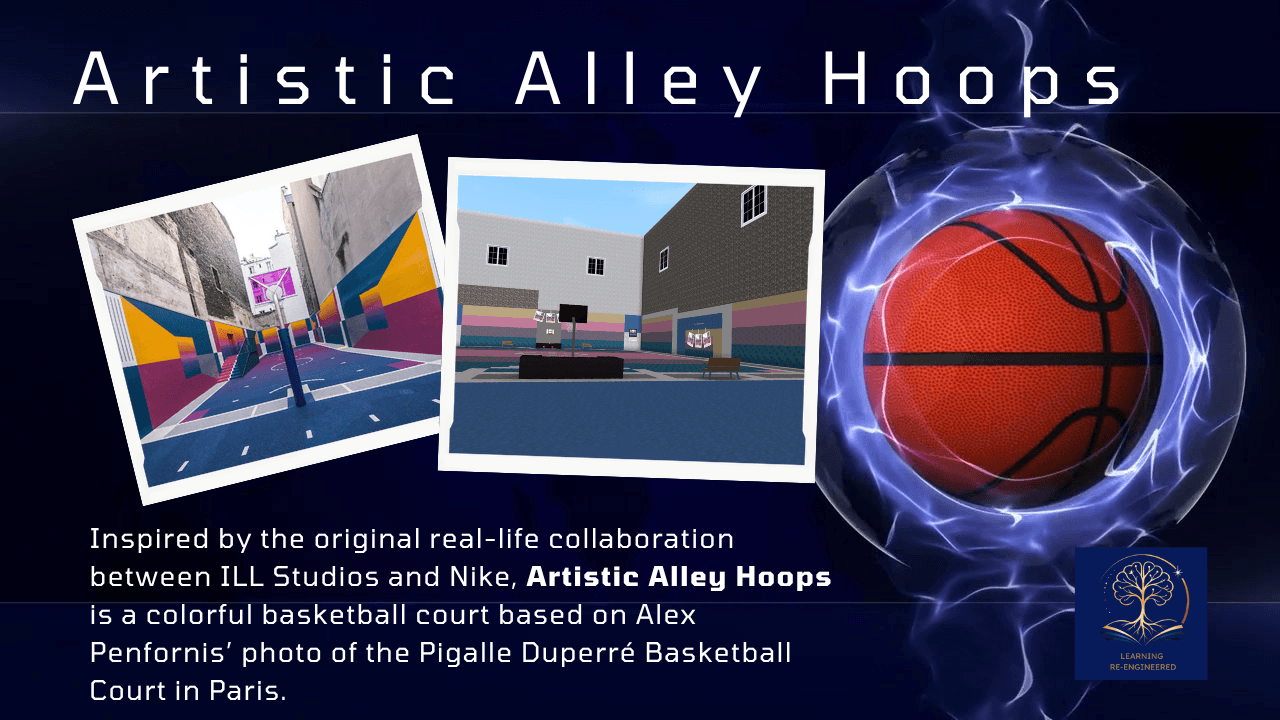
The second story is about how basketball came to Paris in the early 1900s and grew into the Pigalle court, a basketball court that artists and Nike painted in bright, bold colors. Your child reads or listens to this story the same way, then answers a second set of questions about it.
Once every answer in both sets is right, an exit ticket appears. Your child carries it to the teacher's desk and places it in the basket. A door in the game opens, and they see the basketball court itself. The game then shows them how to move and throw the ball.
Every step was designed around how the brain actually builds memory that lasts.
Most educational activities are built for completion. This one is built for understanding.
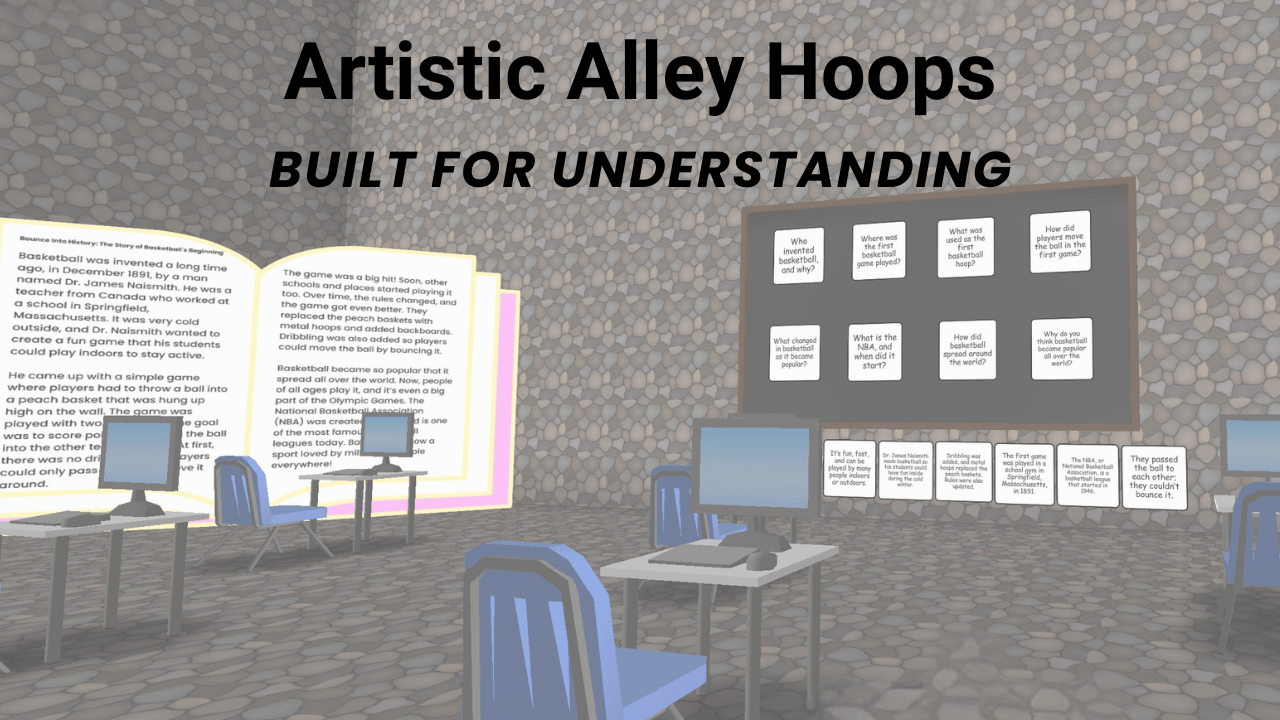
When your child drags the correct answer to a question instead of reading and moving on, that means they retrieved the answer from memory instead of just recognizing it on the page. Retrieving information is what makes a memory stronger, more than reading the same information again does.
When your child physically interacts with the story, choosing and dragging each answer instead of only reading it, the brain stores that information differently than it does from reading alone.
When your child knows the court is waiting for them at the end, they have a specific reason to remember what they read, not just finish the questions and move on.
This is brain-based instructional design applied to reading comprehension. And it works.
The activity moves through four moments, and each one is doing specific work.
In the first moment, your child reads the story of how basketball was invented in 1891, either on their own or with the book read aloud to them.
In the second moment, your child answers questions about that story by dragging each answer choice to match the correct question. They don't move forward until every answer is right.
In the third moment, your child reads the second story, about how basketball came to Paris and grew into the Pigalle court, then answers a second set of questions about it the same way.
In the fourth moment, your child collects the exit ticket that appears once every answer in both sets is correct and carries it to the teacher's desk. A door in the game opens, and your child sees the basketball court itself, where the game shows them how to move and throw the ball.
By the end of the activity, your child has read two true stories, answered every question correctly, and reached the same basketball court they just read about. That's a different kind of knowing.
This isn't just a reading activity. It's a place your child could stand in one day.
The court your child sees at the end of this activity is real. It's the Pigalle court in Paris, painted by artists and Nike in bright, bold colors. People travel from all over to see it and play there today.
Your child isn't reading about something made up. They're reading a true story about how basketball began and grew, and then playing on a version of a real place inside the game.
Your child finishes this activity with two kinds of growth.
The first is real-world knowledge. They know basketball was invented in 1891 by a teacher named Dr. James Naismith, who wanted his students to have a game they could play indoors during the winter. They know the first games were played with peach baskets and no dribbling. They know basketball came to Paris in the early 1900s and grew into the Pigalle court, a court that artists and Nike painted in bright, bold colors. They know the basics of how to move and throw a basketball.
The second is reading skill. They've practiced reading nonfiction for a specific reason. They've practiced retrieving the correct answer from memory rather than guessing. They've practiced following instructions inside the game to learn something new.
Those two things reinforce each other. A child who finishes a reading activity and can do something with what they read starts the next one more capable than before.
This activity was built to work across the different ways families choose to educate.
Whether you're a classroom teacher looking for a nonfiction reading activity your students will actually want to finish, a homeschool parent who needs something your child can work through independently, a tutor or microschool educator looking for a reading comprehension activity with a real payoff, or a parent of a kid who loves basketball and needs a reason to enjoy reading, this activity was built to work in your context.
No download needed. No installation. Your child accesses it directly in the browser the moment you sign up.
This is what parents are saying about Learning Quests™.

“He finished the whole quest and asked if there were more. That’s a first.”
- Parent of a 1st Grader, after trying the tutorial Learning Quest
“For the first time, he actually wanted to finish an educational activity and felt proud when he did!”
- Parent of a 5th Grader, after trying the tutorial Learning Quest
“My daughter used to be afraid to read aloud or answer questions. Now, she does it with confidence.”
- Parent of a 2nd Grader
Every child has the capacity to grow. This activity was designed to make that possible.
Your child is ready to prove what they can remember. Give them a free reading quest that turns real history into a place they can play in, built around how the brain actually learns.
No download. No pressure. Just real understanding.
By signing up, you'll receive access to the activity and occasional updates from Learning Quests™. You can unsubscribe at any time.

Learning Quests™ are brain-based, story-driven skill adventures that help kids build confidence through meaningful learning.
An initiative of Learning Re-Engineered, created for families who want more than just busy work.
© 2020–2026 Learning Re-Engineered. All rights reserved.